Difference between revisions of "And Then There Were None"
(Created article) |
|||
| (24 intermediate revisions by the same user not shown) | |||
| Line 1: | Line 1: | ||
| − | '''''And Then There Were None''''' is | + | [[File:Ten little niggers book cover.jpg|thumb|250px|[https://images1.bonhams.com/image?src=Images/live/2018-02/16/94613987-1-1.jpeg&width=640&height=480&autosizefit=1 Ten Little Niggers, FIRST EDITION, Collins, for The Crime Club,1939]|left]] |
| + | '''''And Then There Were None''''' is one of the classics. A mystery novel written by [https://en.wikipedia.org/wiki/Agatha_Christie Agatha Christie]. It was first published on 6 November 1939, in the United Kingdom by the [https://en.wikipedia.org/wiki/Collins_Crime_Club Collins Crime Club] as '''''Ten Little Niggers'''''. The book was named after the children's [[Ten Little Indians]] and minstrel song.<ref>Peers, Chris; Spurrier, Ralph; Sturgeon, Jamie (1999). ''Collins Crime Club: a checklist of the first editions'' (2nd ed.). London, UK: Dragonby Press. p. 15. ISBN [https://en.wikipedia.org/wiki/Special:BookSources/1-871122-13-9 1-871122-13-9].</ref> | ||
| − | The book is the world's best-selling mystery, and with over 100 million copies sold is one of the best-selling books of all time. Publications International lists the novel as the sixth best-selling title.<ref>Davies, Helen; Dorfman, Marjorie; Fons, Mary; Hawkins, Deborah; Hintz, Martin; Lundgren, Linnea; Priess, David; Clark Robinson, Julia; Seaburn, Paul; Stevens, Heidi; Theunissen, Steve (14 September 2007). "21 Best-Selling Books of All Time". Editors of Publications International, Ltd. Archived from the original on 7 April 2009. Retrieved 25 March 2009.</ref> | + | The book is the world's best-selling mystery, and with over 100 million copies sold is one of the best-selling books of all time. Publications International lists the novel as the sixth best-selling title.<ref>Davies, Helen; Dorfman, Marjorie; Fons, Mary; Hawkins, Deborah; Hintz, Martin; Lundgren, Linnea; Priess, David; Clark Robinson, Julia; Seaburn, Paul; Stevens, Heidi; Theunissen, Steve (14 September 2007). [http://entertainment.howstuffworks.com/21-best-selling-books-of-all-time.htm "21 Best-Selling Books of All Time"]. Editors of Publications International, Ltd. [https://web.archive.org/web/20090407002704/http://entertainment.howstuffworks.com/21-best-selling-books-of-all-time.htm Archived] from the original on 7 April 2009. Retrieved 25 March 2009.</ref> |
| − | == Plot | + | ==Plot== |
| − | The | + | The novel is about a large murder mystery based on an infamous blackface minstrel song that describes a group of people who die one by one under a strange circumstances. The book was re-titled ''And Then There Were None'' in 1940 because of the original title was considered racist. In 1964, it was also published as Ten Little Indians.<ref>[https://www.biblio.com/ten-little-niggers-by-christie-agatha/work/290352 Ten Little Niggers by Agatha Christie]. ''biblio.com''. Retrieved Jan 13, 2021</ref> |
| − | + | Each of the victim in the book was killed in a way each line of the song rhymes. | |
| − | |||
| − | |||
| − | |||
| − | ''Five little | + | {| class="wikitable" |
| + | |+Deaths described in the book vs the original rhyme | ||
| + | !Character | ||
| + | !Mode of Death | ||
| + | !Original Rhyme<ref>[https://ufdc.ufl.edu/UF00026617/00001 The Ten Little Niggers] by M' Loughlin Bro's. New York Publishers.</ref> | ||
| + | |- | ||
| + | |'''Anthony James Marston''' | ||
| + | |Choked after drinking poisoned whisky | ||
| + | |"Ten little nigger boys went out to dine; | ||
| + | One choked his little self and then there were Nine." | ||
| + | |- | ||
| + | |'''Mrs Ethel Rogers''' | ||
| + | |Dies in her sleep of an unknown cause | ||
| + | |"Nine little nigger boys sat up very late; | ||
| + | One overslept himself and then there were Eight." | ||
| + | |- | ||
| + | |'''General John Gordon MacArthur''' | ||
| + | |Killed by a heavy blow to the head | ||
| + | |"Eight little nigger boys travelling in Devon; | ||
| + | One said he'd stay there and then there were Seven." | ||
| + | |- | ||
| + | |'''Thomas Rogers''' | ||
| + | |Killed with an axe while chopping wood | ||
| + | |"Seven little nigger boys chopping up sticks; | ||
| + | One chopped himself in halves and then there were Six." | ||
| + | |- | ||
| + | |'''Emily Caroline Brent''' | ||
| + | |Injected with poison | ||
| + | |"Six little nigger boys playing with a hive; | ||
| + | A bumble-bee stung one and then there were Five." | ||
| + | |- | ||
| + | |'''Lawrence John Wargrave (Mr Justice Wargrave)''' | ||
| + | |Gunshot wound to the head, while dressed as a judge | ||
| + | |"Five little nigger boys going in for law; | ||
| + | One got in Chancery and then there were Four." | ||
| + | |- | ||
| + | |'''Dr Edward George Armstrong''' | ||
| + | |Drowns after being pushed over a cliff into the sea | ||
| + | |"Four little nigger boys going out to sea; | ||
| + | A red herring swallowed one and then there were Three." | ||
| + | |- | ||
| + | |'''William Henry Blore''' | ||
| + | |Crushed to death by a marble clock shaped like a bear | ||
| + | |"Three little nigger boys walking in the zoo; | ||
| + | A big bear hugged one and then there were Two." | ||
| + | |- | ||
| + | |'''Philip Lombard''' | ||
| + | |Shot by Vera on the beach | ||
| + | |"Two little nigger boys sitting in the sun; | ||
| + | One got frizzled up and then there was One." | ||
| + | |- | ||
| + | |'''Vera Elizabeth Claythorne''' | ||
| + | |Hangs herself | ||
| + | |"One little nigger boy left all alone; | ||
| + | He went and hanged himself and then there were None." | ||
| + | |} | ||
| − | + | ==Controversy== | |
| + | [[File:Ten little niggers.jpg|thumb|250px|Ten Little Niggers book cover]] | ||
| + | The book cover is an image of “black” doll or golliwog, hanging. According to Ferris State University’s Jim Crow Museum of Racist Memorabilia website are “grotesque creatures, with very dark, often jet black skin, large white-rimmed eyes, red or white clown lips, and wild frizzy hair.”<ref>[https://rethinkingschools.org/articles/rethinking-agatha-christie/ Rethinking Agatha Christie: The strange and offensive history of Ten Little Indians]. ''rethinkingschools.com''. Retrieved Jan 13, 2021</ref> | ||
| − | '' | + | The book was originally titled ''Ten Little Niggers'' coming from a highly racist lullaby back in the time. Having it inspired from the nursery rhyme, it was never Christie's intention to use the racial slur. By the time the book was written, the language and word used was different. However, it still becomes a problem in current times.''<ref>[https://aldianews.com/articles/culture/literature/agatha-christie-under-anti-racist-spotlight-her-most-famous-novel Agatha Christie under the anti-racist spotlight: Her most famous novel changes titles]. ''aldianews.com''. August 27, 2020. Retrieved Jan 13, 20221</ref> ''Literary critic, Eric Naulleau'', ''mentioned that the title Ten Little Niggers'' "came from a time when such language was common."<ref name="rfi">[https://www.rfi.fr/en/culture/20200826-n-word-scrapped-from-french-edition-of-agatha-christie-novel-crime-negro-offence-black-lives-matter 'N-word' scrapped from French edition of Agatha Christie novel]. ''refi.fr''. Aug 26, 2020. Retrieved Jan 13, 2021</ref> '' |
| + | However, due to the controversy, in the French translation of the book, the word "nègre" will be replaced with the word "soldat" or "soldier" in the latest translation.<ref name="rfi" /> | ||
| − | + | ==References== | |
| − | + | {{reflist}} | |
| − | + | [[Category:Black-Targeted Racism in Mystery Novels]] | |
| − | + | [[Category:Racism in Classics]] | |
| − | = | ||
| − | |||
| − | |||
| − | |||
| − | |||
| − | |||
| − | |||
| − | |||
| − | |||
| − | |||
| − | |||
| − | |||
| − | |||
| − | |||
| − | [[Category: | ||
Latest revision as of 09:18, 15 March 2021

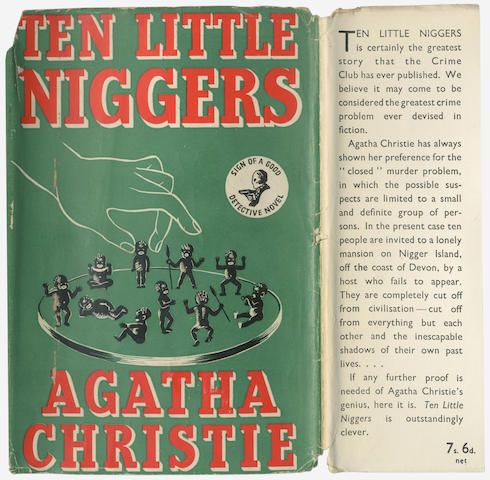
And Then There Were None is one of the classics. A mystery novel written by Agatha Christie. It was first published on 6 November 1939, in the United Kingdom by the Collins Crime Club as Ten Little Niggers. The book was named after the children's Ten Little Indians and minstrel song.[1]
The book is the world's best-selling mystery, and with over 100 million copies sold is one of the best-selling books of all time. Publications International lists the novel as the sixth best-selling title.[2]
Plot
The novel is about a large murder mystery based on an infamous blackface minstrel song that describes a group of people who die one by one under a strange circumstances. The book was re-titled And Then There Were None in 1940 because of the original title was considered racist. In 1964, it was also published as Ten Little Indians.[3]
Each of the victim in the book was killed in a way each line of the song rhymes.
| Character | Mode of Death | Original Rhyme[4] |
|---|---|---|
| Anthony James Marston | Choked after drinking poisoned whisky | "Ten little nigger boys went out to dine;
One choked his little self and then there were Nine." |
| Mrs Ethel Rogers | Dies in her sleep of an unknown cause | "Nine little nigger boys sat up very late;
One overslept himself and then there were Eight." |
| General John Gordon MacArthur | Killed by a heavy blow to the head | "Eight little nigger boys travelling in Devon;
One said he'd stay there and then there were Seven." |
| Thomas Rogers | Killed with an axe while chopping wood | "Seven little nigger boys chopping up sticks;
One chopped himself in halves and then there were Six." |
| Emily Caroline Brent | Injected with poison | "Six little nigger boys playing with a hive;
A bumble-bee stung one and then there were Five." |
| Lawrence John Wargrave (Mr Justice Wargrave) | Gunshot wound to the head, while dressed as a judge | "Five little nigger boys going in for law;
One got in Chancery and then there were Four." |
| Dr Edward George Armstrong | Drowns after being pushed over a cliff into the sea | "Four little nigger boys going out to sea;
A red herring swallowed one and then there were Three." |
| William Henry Blore | Crushed to death by a marble clock shaped like a bear | "Three little nigger boys walking in the zoo;
A big bear hugged one and then there were Two." |
| Philip Lombard | Shot by Vera on the beach | "Two little nigger boys sitting in the sun;
One got frizzled up and then there was One." |
| Vera Elizabeth Claythorne | Hangs herself | "One little nigger boy left all alone;
He went and hanged himself and then there were None." |
Controversy

The book cover is an image of “black” doll or golliwog, hanging. According to Ferris State University’s Jim Crow Museum of Racist Memorabilia website are “grotesque creatures, with very dark, often jet black skin, large white-rimmed eyes, red or white clown lips, and wild frizzy hair.”[5]
The book was originally titled Ten Little Niggers coming from a highly racist lullaby back in the time. Having it inspired from the nursery rhyme, it was never Christie's intention to use the racial slur. By the time the book was written, the language and word used was different. However, it still becomes a problem in current times.[6] Literary critic, Eric Naulleau, mentioned that the title Ten Little Niggers "came from a time when such language was common."[7] However, due to the controversy, in the French translation of the book, the word "nègre" will be replaced with the word "soldat" or "soldier" in the latest translation.[7]
References
- ↑ Peers, Chris; Spurrier, Ralph; Sturgeon, Jamie (1999). Collins Crime Club: a checklist of the first editions (2nd ed.). London, UK: Dragonby Press. p. 15. ISBN 1-871122-13-9.
- ↑ Davies, Helen; Dorfman, Marjorie; Fons, Mary; Hawkins, Deborah; Hintz, Martin; Lundgren, Linnea; Priess, David; Clark Robinson, Julia; Seaburn, Paul; Stevens, Heidi; Theunissen, Steve (14 September 2007). "21 Best-Selling Books of All Time". Editors of Publications International, Ltd. Archived from the original on 7 April 2009. Retrieved 25 March 2009.
- ↑ Ten Little Niggers by Agatha Christie. biblio.com. Retrieved Jan 13, 2021
- ↑ The Ten Little Niggers by M' Loughlin Bro's. New York Publishers.
- ↑ Rethinking Agatha Christie: The strange and offensive history of Ten Little Indians. rethinkingschools.com. Retrieved Jan 13, 2021
- ↑ Agatha Christie under the anti-racist spotlight: Her most famous novel changes titles. aldianews.com. August 27, 2020. Retrieved Jan 13, 20221
- ↑ 7.0 7.1 'N-word' scrapped from French edition of Agatha Christie novel. refi.fr. Aug 26, 2020. Retrieved Jan 13, 2021