Difference between revisions of "Template:Comparison satellite navigation orbits"
Jump to navigation
Jump to search

imported>Daranz m (<noinclude>{{Template reference list|lower-alpha}}</noinclude>) |
imported>Cmglee (Update caption for updated SVG) |
||
| Line 1: | Line 1: | ||
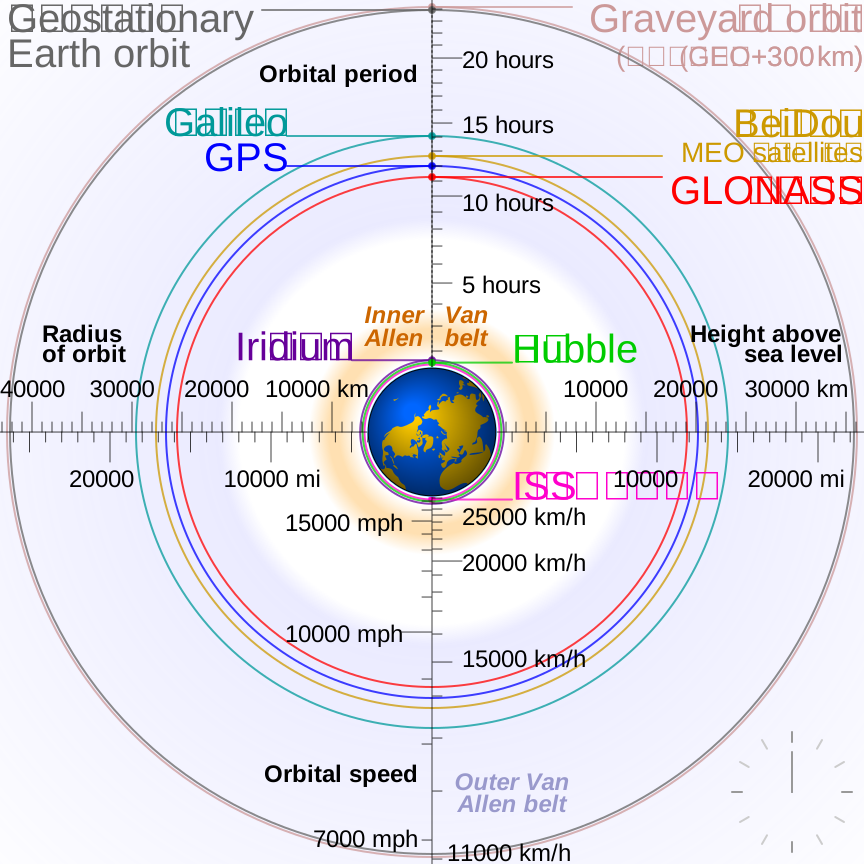
| − | [[Image:Comparison_satellite_navigation_orbits.svg|thumb| | + | [[Image:Comparison_satellite_navigation_orbits.svg|thumb|{{{1|250px}}}|Comparison of [[Geostationary Earth Orbit|geostationary]], '''[[GPS]]''', '''[[GLONASS]]''', '''[[Galileo_(satellite_navigation)|Galileo]]''', '''[[Compass_navigation_system|Compass (medium earth orbit)]]''', [[International Space Station]], [[Hubble Space Telescope]] and [[Iridium constellation]] orbits, with the [[Van Allen radiation belts]] and the [[Earth]].<ref group=lower-alpha>Orbital periods and speeds are calculated using the relations 4π²''R''³ = ''T''²''GM'' and ''V''²''R'' = ''GM'', where ''R'' = radius of orbit in metres, ''T'' = orbital period in seconds, ''V'' = orbital speed in m/s, ''G'' = gravitational constant ≈ 6.673{{e|-11}} Nm²/kg², ''M'' = mass of Earth ≈ 5.98{{e|24}} kg.</ref> The [[Moon]]'s orbit is around 9 times larger (in radius and length) than geostationary orbit.<ref group=lower-alpha>Approximately 8.6 times when the moon is nearest (363 104 km ÷ 42 164 km) to 9.6 times when the moon is farthest (405 696 km ÷ 42 164 km).</ref> (In [http://upload.wikimedia.org/wikipedia/commons/b/b4/Comparison_satellite_navigation_orbits.svg the SVG file,] hover over an orbit or its label to highlight it, and click to load its article.)]]<noinclude>{{Template reference list|lower-alpha}}</noinclude> |
Revision as of 22:36, 16 April 2016

Comparison of geostationary, GPS, GLONASS, Galileo, Compass (medium earth orbit), International Space Station, Hubble Space Telescope and Iridium constellation orbits, with the Van Allen radiation belts and the Earth.[lower-alpha 1] The Moon's orbit is around 9 times larger (in radius and length) than geostationary orbit.[lower-alpha 2] (In the SVG file, hover over an orbit or its label to highlight it, and click to load its article.)
References
- ↑ Orbital periods and speeds are calculated using the relations 4π²R³ = T²GM and V²R = GM, where R = radius of orbit in metres, T = orbital period in seconds, V = orbital speed in m/s, G = gravitational constant ≈ 6.673×10⁻¹¹ Nm²/kg², M = mass of Earth ≈ 5.98×1024 kg.
- ↑ Approximately 8.6 times when the moon is nearest (363 104 km ÷ 42 164 km) to 9.6 times when the moon is farthest (405 696 km ÷ 42 164 km).