Difference between revisions of "Peter Pan"
| Line 1: | Line 1: | ||
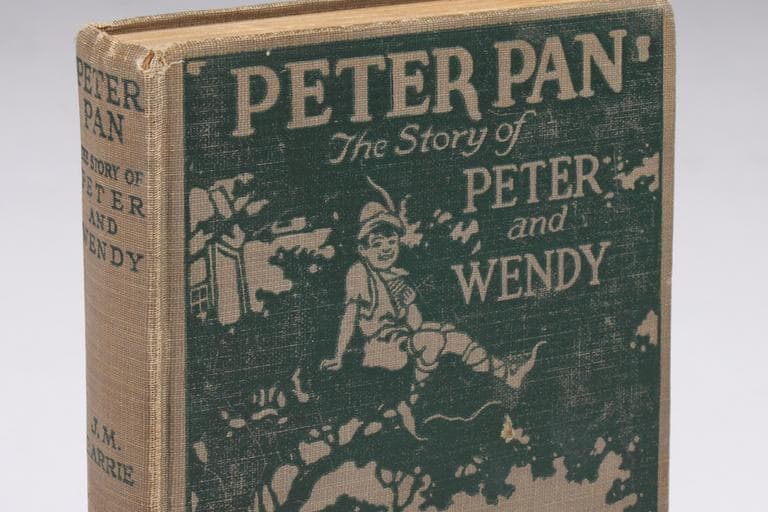
[[File:Peter Pan Book cover.jpg|thumb|[https://wordpress.wbur.org/wp-content/uploads/2011/10/1011_peterpan_crop-768x512.jpg Peter Pan 1911 Book Cover]]] | [[File:Peter Pan Book cover.jpg|thumb|[https://wordpress.wbur.org/wp-content/uploads/2011/10/1011_peterpan_crop-768x512.jpg Peter Pan 1911 Book Cover]]] | ||
| − | Peter Pan; or, '''''the Boy Who Wouldn't Grow Up''''' or '''''Peter and Wendy''''', often known simply as '''''Peter Pan''''' is a work by [https://en.wikipedia.org/wiki/J._M._Barrie J.M. Barrie]. He is a free | + | Peter Pan; or, '''''the Boy Who Wouldn't Grow Up''''' or '''''Peter and Wendy''''', often known simply as '''''Peter Pan''''' is a work by [https://en.wikipedia.org/wiki/J._M._Barrie J.M. Barrie]. He is a free and mischievous young boy who can fly and never grows up. Peter Pan spends his never-ending childhood having adventures on the mythical island of [https://en.wikipedia.org/wiki/Neverland Neverland]. The Peter Pan stories has other key characters such as Wendy Darling and her two brothers, Peter's fairy Tinker Bell, the Lost Boys, and the pirate Captain Hook.<ref name=peterwendy>https://en.wikipedia.org/wiki/Peter_and_Wendy</ref> The novel was first published in 1911 by [https://en.wikipedia.org/wiki/Hodder_%26_Stoughton Hodder & Stoughton] in the UK, and [https://en.wikipedia.org/wiki/Charles_Scribner%27s_Sons Charles Scribner's Sons] in the US. |
== Plot == | == Plot == | ||
| − | The book | + | The book tells the story of the adventurous Peter Pan on an island called Neverland. Together with Wendy Darling and her brothers, the fairy Tinker Bell, |
| + | the Lost Boys, the Indian princess Tiger Lily, and the pirate Captain Hook, their magical trip to Neverland is followed by many adventures.<ref name=peterwendy/> | ||
== Controversy == | == Controversy == | ||
| − | [[File:Paterpan1.jpg|thumb|left]]The author describes Neverland’s Indians | + | [[File:Paterpan1.jpg|thumb|left]]The author describes Neverland’s Indians (they are native of the land) in a very stereotypical way; |
<blockquote>''“They carry tomahawks and knives, and their naked bodies gleam with paint and oil. Strung around them are scalps, of boys as well as of pirates, for these are the [https://en.wikipedia.org/wiki/Pickaninny Piccaninny] tribe, and not to be confused with the softer-hearted Delawares or the Hurons.”''</blockquote> | <blockquote>''“They carry tomahawks and knives, and their naked bodies gleam with paint and oil. Strung around them are scalps, of boys as well as of pirates, for these are the [https://en.wikipedia.org/wiki/Pickaninny Piccaninny] tribe, and not to be confused with the softer-hearted Delawares or the Hurons.”''</blockquote> | ||
| − | + | Moreover, they are also displayed in stereotypical characteristics such as speaking in grunts and calling Peter Pan the "great white father."<ref>https://www.insider.com/classic-childrens-books-that-havent-aged-well-2019-5#while-jm-barries-classic-peter-pan-is-beloved-by-many-his-depiction-of-the-native-americans-in-neverland-are-problematic-for-readers-today-5</ref> J.M. Barrier described Neverland as an island of ''"coral reefs and rakish-looking craft in the offing, and savages and lonely lairs, and gnomes who are mostly tailors, and caves through which a river runs, and princes with six elder brothers...and one very small old lady with a hooked nose."''<ref name=smithsonianmag>https://www.smithsonianmag.com/arts-culture/racist-history-peter-pan-indian-tribe-180953500/</ref> ''New York Times'' reviewer wrote in 1905, ''"Mr. Barrie presents not the pirate or Indian of grown-up fiction but the creations seen by childish eyes."'' In practice, that meant portraying the fierce tribe that lives on Neverland in a way that even in the early 20th-century looked like a caricature.<ref name=smithsonianmag /> | |
| − | + | This portrayal was not a problem back in the time, however it becomes a problem for recent productions. There's no real reason for a tribe of Native Americans —''"not to be confused with the softer-hearted Delawares or the Hurons,"'' Barrie wrote—to live on Neverland, where they are impossible to excise from the story. It's almost impossible to depict them in a way that's not offensive.<ref name=smithsonianmag /> | |
== References == | == References == | ||
Revision as of 04:39, 22 February 2021

Peter Pan; or, the Boy Who Wouldn't Grow Up or Peter and Wendy, often known simply as Peter Pan is a work by J.M. Barrie. He is a free and mischievous young boy who can fly and never grows up. Peter Pan spends his never-ending childhood having adventures on the mythical island of Neverland. The Peter Pan stories has other key characters such as Wendy Darling and her two brothers, Peter's fairy Tinker Bell, the Lost Boys, and the pirate Captain Hook.[1] The novel was first published in 1911 by Hodder & Stoughton in the UK, and Charles Scribner's Sons in the US.
Plot
The book tells the story of the adventurous Peter Pan on an island called Neverland. Together with Wendy Darling and her brothers, the fairy Tinker Bell, the Lost Boys, the Indian princess Tiger Lily, and the pirate Captain Hook, their magical trip to Neverland is followed by many adventures.[1]
Controversy

The author describes Neverland’s Indians (they are native of the land) in a very stereotypical way;
“They carry tomahawks and knives, and their naked bodies gleam with paint and oil. Strung around them are scalps, of boys as well as of pirates, for these are the Piccaninny tribe, and not to be confused with the softer-hearted Delawares or the Hurons.”
Moreover, they are also displayed in stereotypical characteristics such as speaking in grunts and calling Peter Pan the "great white father."[2] J.M. Barrier described Neverland as an island of "coral reefs and rakish-looking craft in the offing, and savages and lonely lairs, and gnomes who are mostly tailors, and caves through which a river runs, and princes with six elder brothers...and one very small old lady with a hooked nose."[3] New York Times reviewer wrote in 1905, "Mr. Barrie presents not the pirate or Indian of grown-up fiction but the creations seen by childish eyes." In practice, that meant portraying the fierce tribe that lives on Neverland in a way that even in the early 20th-century looked like a caricature.[3]
This portrayal was not a problem back in the time, however it becomes a problem for recent productions. There's no real reason for a tribe of Native Americans —"not to be confused with the softer-hearted Delawares or the Hurons," Barrie wrote—to live on Neverland, where they are impossible to excise from the story. It's almost impossible to depict them in a way that's not offensive.[3]
References
- ↑ 1.0 1.1 https://en.wikipedia.org/wiki/Peter_and_Wendy
- ↑ https://www.insider.com/classic-childrens-books-that-havent-aged-well-2019-5#while-jm-barries-classic-peter-pan-is-beloved-by-many-his-depiction-of-the-native-americans-in-neverland-are-problematic-for-readers-today-5
- ↑ 3.0 3.1 3.2 https://www.smithsonianmag.com/arts-culture/racist-history-peter-pan-indian-tribe-180953500/