File:Matteo Ricci's way from Macau to Beijing.jpg
Jump to navigation
Jump to search
Size of this preview: 762 × 599 pixels. Other resolutions: 305 × 240 pixels | 610 × 480 pixels | 763 × 600 pixels | 977 × 768 pixels | 1,280 × 1,007 pixels | 2,421 × 1,904 pixels.
Original file (2,421 × 1,904 pixels, file size: 4.68 MB, MIME type: image/jpeg)
Summary
| Description |
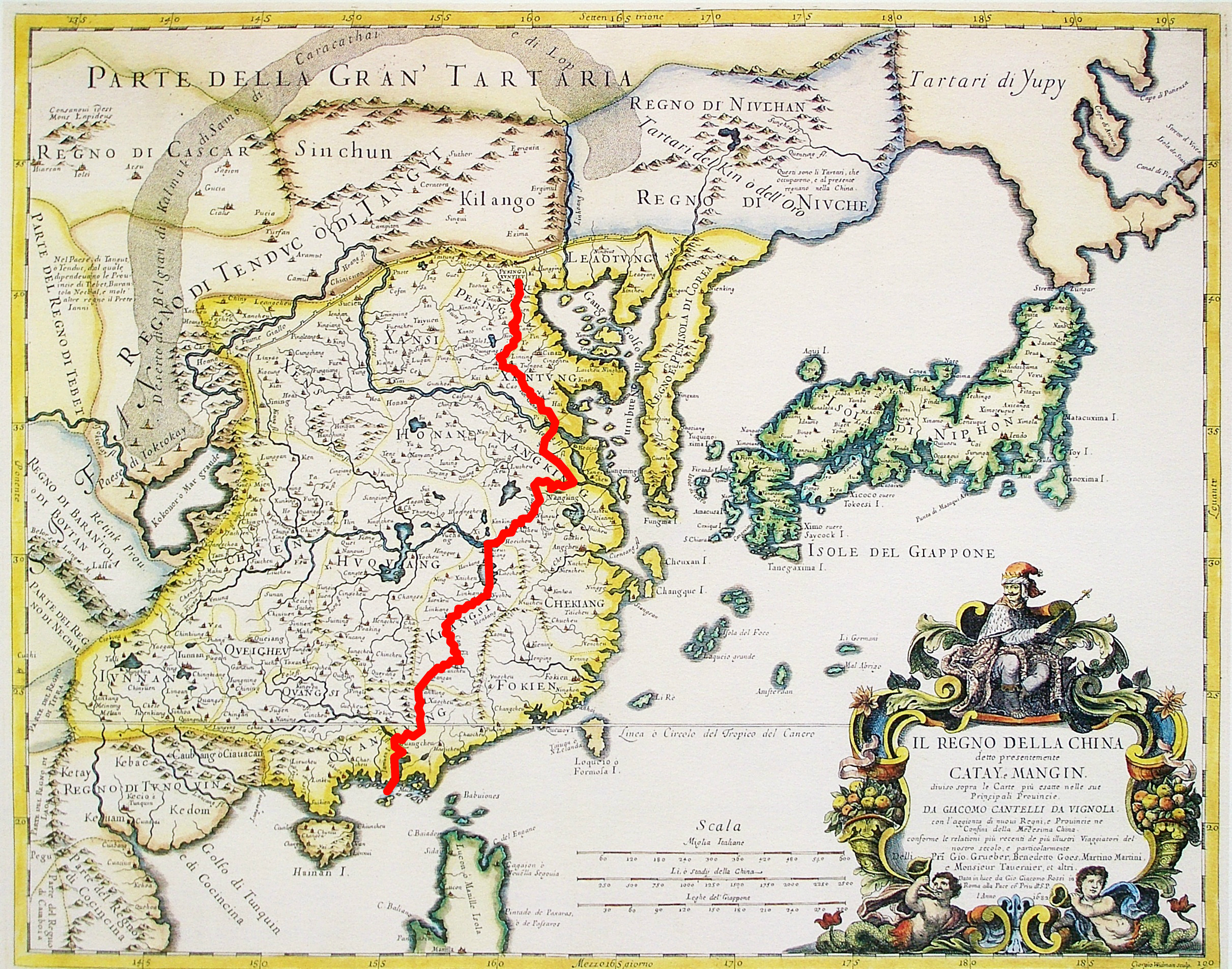
English: Matteo Ricci's way from Macao to Beijing in 16th century. The same route was later followed (or partially followed) by Portuguese artillerists like Gonçalo Teixeira Correa demonstrating their skill and technology to the imperial court in the 1620s and 1630s.
Magyar: Matteo Ricci útja Makaótól Pekingig a 16. században |
| Date | The map was originally published in 1682; the copy at HKUST is a 1689 reprint. |
| Source |
This file was derived from: CEM-36-Regno-della-China-2355.jpg |
| Author | Giacomo Cantelli (1643-1695), Giovanni Giacomo de Rossi (17th century) |
Licensing
|
This is a faithful photographic reproduction of a two-dimensional, public domain work of art. The work of art itself is in the public domain for the following reason:
The official position taken by the Wikimedia Foundation is that "faithful reproductions of two-dimensional public domain works of art are public domain".
This photographic reproduction is therefore also considered to be in the public domain in the United States. In other jurisdictions, re-use of this content may be restricted; see Reuse of PD-Art photographs for details. | ||||

|
This work is based on a work in the public domain. It has been digitally enhanced and/or modified. This derivative work has been (or is hereby) released into the public domain by its author, LlywelynII. This applies worldwide.
In some countries this may not be legally possible; if so: |
File history
Click on a date/time to view the file as it appeared at that time.
| Date/Time | Thumbnail | Dimensions | User | Comment | |
|---|---|---|---|---|---|
| current | 07:21, 5 June 2017 | | 2,421 × 1,904 (4.68 MB) | LlywelynII | fixed lines; quality |
File usage
The following page uses this file:


